


Today there is talk of war everywhere. Everyone fears a war breaking out between the two countries. If that happens it will be a calamity both for India and for Pakistan. India has written to the U.N. because whenever there is a fear of conflict anywhere the U.N. is asked to promote a settlement and to stop fighting from breaking out. India therefore wrote to the U. N. O. however trivial the issue may appear to be, it could lead to a war between the two countries. It is a long memorandum and it has been cabled. Pakistan’s leaders Zafrullah Khan and Liaquat Ali Khan have since issued long statements. I would take leave to say that their argument does not appeal to me. You may ask if I approve of the Union Government approaching the UNO I may say that I both approve and do not approve of what they did. I approve of it, because after all what else are they to do? They are convinced that what they are doing is right. If there are raids from outside the frontier of Kashmir, the obvious conclusion is that it must be with the connivance of Pakistan. Pakistan can deny it. But the denial does not settle the matter. Kashmir has acceded the accession upon certain conditions. If Pakistan harasses Kashmir and if Sheikh Abdullah who is the leader of Kashmir asks the Indian Union for help, the latter is bound to send help. Such help therefore was sent to Kashmir. At the same time Pakistan is being requested to get out of Kashmir and to arrive at a settlement with India over the question through bilateral negotiations. If no settlement can be reached in this way then a war is inevitable. It is to avoid the possibility of war that the Union Government has taken the step it did. Whether they are right in doing so or not God alone knows. Whatever might have been the attitude of Pakistan, if I had my way I would have invited Pakistan’s representatives to India and we could have met, discussed the matter and worked out some settlement. They keep saying that they want an amicable settlement but they do nothing to create the conditions for such a settlement. I shall therefore humbly say to the responsible leaders of Pakistan that though we are now two countries – which is a thing I never wanted – we should at least try to arrive at an agreement so that we could live as peaceful neighbors. Let us grant for the sake of argument that all Indians are bad, but Pakistan at least is a new-born nation which has more ever come into being in the name of religion and it should at least keep itself clean. But they themselves make no such claim. It is not their argument that Muslims have committed no atrocities in Pakistan. I shall therefore suggest that it is now their duty, as far as possible, to arrive at an amicable understanding with India and live in harmony with her. Mistakes were made on both sides. Of this o have no doubt. But this does not mean that we should persist in those mistakes, for then in the end we shall only destroy ourselves in a war and the whole of the sub-continent will pass into the hands of some third power. That will be the worst imaginable fate for us. I shudder to think of it. Therefore the two Dominions should come together with God as witness and find a settlement. The matter is now before the UNO. It cannot be withdrawn from there. But if India and Pakistan come to a settlement the big powers in the UNO will have to endorse that settlement. They will not object to the settlement. They themselves can only say that they will do their best to see that the two countries arrive at an understanding through mutual discussions. Let us pray to God is to grant that we may either learn to live in amity with each other or if we must light to let us fight to the very end. That may be folly but sooner or later it will purify us. Now a few words about Delhi. I came to know of the incidents which took place last evening through Brijkishan. I had gone to the Camp for the evening prayer. I came away after the prayer but he had stayed over to talk to the people in the Camp. There are some Muslim houses at as little distance from the Camp. About four or five hundred inmates of the Camp mostly women and children but also some men – issued out of the Camp to take possession of the houses. I am told they did not indulge in any kind of violence. Some of the houses were vacant. Some were occupied by the owners. They tried to take possession even of the latter. The police were near at hand. They immediately went to the spot and brought the situation under control at about 9 O’ clock according to the information I have. The police have stayed on there. I understand they had to use tear gas. Tear gas does not kill but it can be pretty painful. I am told that something has happened today again.
All I can say is that is a matter of great shame for us. Have not the refugees learnt even from their immense suffering that they have to exercise some restraint? It is highly improper to go and occupy other people’s houses. It is for the Government to find them shelter or whatever else their need. Today the Government is our own. But if we defy our own Government and defy the police and forcibly occupy houses the Government is not likely to continue for long. It is still worse that such things should happen in the capital city of India where there are so many ambassadors from all over the world. Do we want to show them the spectacle of people occupying what-ever they can? It is all the more regrettable that women and children were used as a shield. It is inhuman. It is like Muslim rulers keeping a herd of cows in the anguard of their armies to make sure that the Hindus would not fight. It is uncivilized, barbaric behavior. It is still more barbaric to put women and children in front to provide against the police making a lathi charge. It is abuse of womanhood. I must humbly ask all the refugees - women and children – not to behave in this way. Let them settle down. If they don’t, then apart from a war between Indian and Pakistan, we may kill ourselves in mutual strife. We may lose Delhi and make ourselves the laughing-stock of the world. If we want to keep India a free country, we must stop the things that are at present going on.


Mohandas Karamchand Gandhi (1869-1948), also known as Mahatma Gandhi, was born in in the present day state of Gujarat in India on October 2, 1869. He was raised in a very conservative family that had affiliations with the ruling family of Kathiawad. He was educated in law at University College, London. In 1891, after having been admitted to the British bar, Gandhi returned to India and attempted to establish a law practice in Bombay, without much success. Two years later an Indian firm with interests in South Africa retained him as legal adviser in its office in Durban. Arriving in Durban, Gandhi found himself treated as a member of an inferior race. He was appalled at the widespread denial of civil liberties and political rights to Indian immigrants to South Africa. He threw himself into the struggle for elementary rights for Indians.
See Also: Parentage and Childhood from Gandhi's autobiography
Resistance to Injustice
Gandhi remained in South Africa for twenty years, suffering imprisonment many times. In 1896, after being attacked and humilated by white South Africans, Gandhi began to teach a policy of passive resistance to, and non-cooperation with, the South African authorities. Part of the inspiration for this policy came from the Russian writer Leo Tolstoy, whose influence on Gandhi was profound. Gandhi also acknowledged his debt to the teachings of Christ and to the 19th-century American writer Henry David Thoreau, especially to Thoreau's famous essay "Civil Disobedience." Gandhi considered the terms passive resistance and civil disobedience inadequate for his purposes, however, and coined another term, Satyagraha (from Sanskrit, "truth and firmness"). During the Boer War, Gandhi organized an ambulance corps for the British army and commanded a Red Cross unit. After the war he returned to his campaign for Indian rights. In 1910, he founded Tolstoy Farm, near Durban, a cooperative colony for Indians. In 1914 the government of the Union of South Africa made important concessions to Gandhi's demands, including recognition of Indian marriages and abolition of the poll tax for them. His work in South Africa complete, he returned to India.

Campaign for Home Rule
 Gandhi became a leader in a complex struggle, the Indian campaign for home rule Following World War I, in which he played an active part in recruiting campaigns, Gandhi, again advocating Satyagraha, launched his movement of non-violent resistance to Great Britain. When, in 1919, Parliament passed the Rowlatt Acts, giving the Indian colonial authorities emergency powers to deal with so-called revolutionary activities, Satyagraha spread throughout India, gaining millions of followers. A demonstration against the Rowlatt Acts resulted in a massacre of Indians at British government failed to make amends, Gandhi proclaimed an organized campaign of non-cooperation. Indians in public office resigned, government agencies such as courts of law were boycotted, and Indian children were withdrawn from government schools. Throughout India, streets were blocked by squatting Indians who refused to rise even when beaten by police. Gandhi was arrested, but the British were soon forced to release him. Economic independence for India, involving the complete boycott of British goods, was made a corollary of Gandhi's Swaraj Arabian Sea, where they made salt by evaporating sea water. Once more the Indian leader was arrested, but he was released in 1931, halting the campaign after the British made concessions to his demands. In the same year Gandhi represented the Indian National Congress at a conference in London
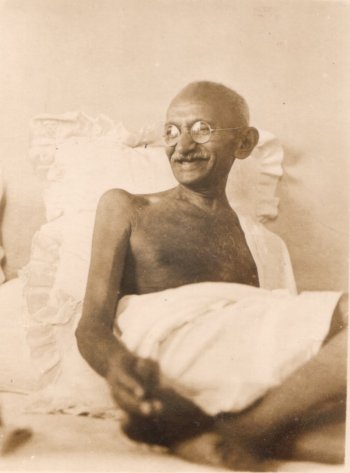
Smiling Gandhi
Photograph by V.N. O'key, circa 1945
Gandhi takes on Domestic Problems
In 1932, Gandhi began new civil-disobedience campaigns against the British. Arrested twice, the Mahatma fasted for long periods several times; these fasts were effective measures against the British, because revolution might well have broken out in India if he had died. In September 1932, while in jail, Gandhi undertook a "fast unto death" to improve the status of the Hindu Untouchables. The British, by permitting the Untouchables to be considered as a separate part of the Indian electorate, were, according to Gandhi, countenancing an injustice. Although he was himself a member of an upper caste, Gandhi was the great leader of the movement in India dedicated to eradicating the unjust social and economic aspects of the caste system.
In 1934 Gandhi formally resigned from politics, being replaced as leader of the Congress party by Jawaharlal Nehru. Gandhi traveled through India, teaching ahimsa and demanding eradication of "untouchability." The esteem in which he was held was the measure of his political power. So great was this power that the limited home rule granted by the British in 1935 could not be implemented until Gandhi approved it. A few years later, in 1939, he again returned to active political life because of the pending federation of Indian principalities with the rest of India. His first act was a fast, designed to force the ruler of the state of Rajkot to modify his autocratic rule. Public unrest caused by the fast was so great that the colonial government intervened; the demands were granted. The Mahatma again became the most important political figure in India.
© K. L. Kamat
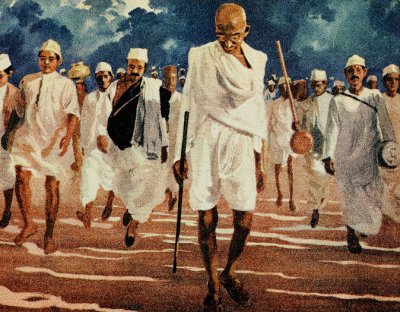
Man of Firm Step
Independence for India
When World War II broke out, the Congress party and Gandhi demanded a declaration of war aims and their application to India. As a reaction to the unsatisfactory response from the British, the party decided not to support Britain in the war unless the country were granted complete and immediate independence. The British refused, offering compromises that were rejected. When Japan entered the war, Gandhi still refused to agree to Indian participation. He was interned in 1942 but was released two years later because of failing health.Kamat's Potpourri
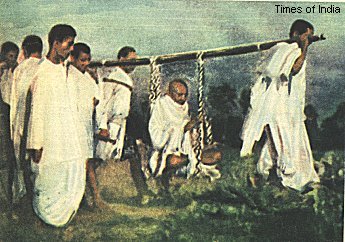
Men Carrying Gandhi, Noakhali
By 1944 the Indian struggle for independence was in its final stages, the British government having agreed to independence on condition that the two contending nationalist groups, the Muslim League and the Congress party, should resolve their differences. Gandhi stood steadfastly against the partition of India but ultimately had to agree, in the hope that internal peace would be achieved after the Muslim demand for separation had been satisfied. India and Pakistan became separate states when the British granted India its independence in 1947 (see: Tryst with Destiny -- the story of India's independence). During the riots that followed the partition of India, Gandhi pleaded with Hindus and Muslims to live together peacefully. Riots engulfed Calcutta, one of the largest cities in India, and the Mahatma fasted until disturbances ceased. On January 13, 1948, he undertook another successful fast in New Delhi to bring about peace, but on January 30, 12 days after the termination of that fast, as he was on his way to his evening prayer meeting, he was assassinated by a fanatic Hindu.
Gandhi's death was regarded as an international catastrophe. His place in humanity was measured not in terms of the 20th century, but in terms of history. A period of mourning was set aside in the United Nations General Assembly, and condolences to India were expressed by all countries. Religious violence soon waned in India and Pakistan, and the teachings of Gandhi came to inspire nonviolent movements elsewhere, notably in the U.S.A. under the civil rights leader Martin Luther King, Jr. and in South Africa under Nelson Mandela.
 Born on 15th October 1931 at Rameswaram, in Tamil Nadu, Dr. Avul Pakir Jainulabdeen Abdul Kalam, specialized in Aero Engineering from Madras Institute of Technology.
He initially worked in DRDO in 1958 and then joined ISRO in 1963. Dr. Kalam has made significant contribution to Indian satellite and launch vehicles of ISRO and also in the missile programme of DRDO. As project Director, SLV-III, he contributed for the design, development and management of India’s first indigenous Satellite Launch Vehicle (SLV-III) to inject Rohini satellite in the near earth orbit. He was responsible for the evolution of ISRO’s launch vehicles programme and configurations. He rejoined DRDO in 1982 and conceived the Integrated Guided Missile Development Programme (IGMDP) for indigenous missiles.
He was Scientific Adviser to Defence Minister and Secretary, Department of Defence Research & Development from July 1992 to December 1999.
As Chairman, Technology Information, Forecasting and Assessment Council (TIFAC), he generated the Technology Vision 2020 documents – a road map for transforming India from Developing India to Developed India. He provided overall guidance to a number of Homegrown Technology Projects and major technology missions such as Sugar, Advanced Composites and Fly Ash utilization.
Dr. Kalam has served as the Principal Scientific Advisor to the Government of India, in the rank of Cabinet Minister, from November 1999 to November 2001. He was primarily responsible for evolving policies, strategies and missions for generation of innovations and support systems for multiple applications. Also, generating science and technology task in strategic, economic and social sectors in partnership with Government departments, institutions and industry. Dr. Kalam was also the Chairman, Ex-officio, of the Scientific Advisory Committee to the Cabinet (SAC-C).
Dr. Kalam took up academic pursuit as Professor, Technology & Societal Transformation at Anna University, Chennai and involved in teaching and research tasks. Above all he is on his mission to ignite the young minds for national development by meeting high school students across the country.
Dr. Kalam was conferred with the Degree of Doctor of Science (D.Sc. Honoris Causa) by 30 universities/academic institutions. He is recipient of several awards including the Indira Gandhi Award for National Integration 1997.
Dr. A.P.J. Abdul Kalam has been awarded Padma Bhushan in 1981, Padma Vibhushan in 1990 and BHARAT RATNA in 1997.